GST & Billing
GST Invoice vs Proforma Invoice: What’s the Difference?
Understand the difference between a GST invoice and a proforma invoice, when each document is used, and how ZyBill helps businesses create and manage both.
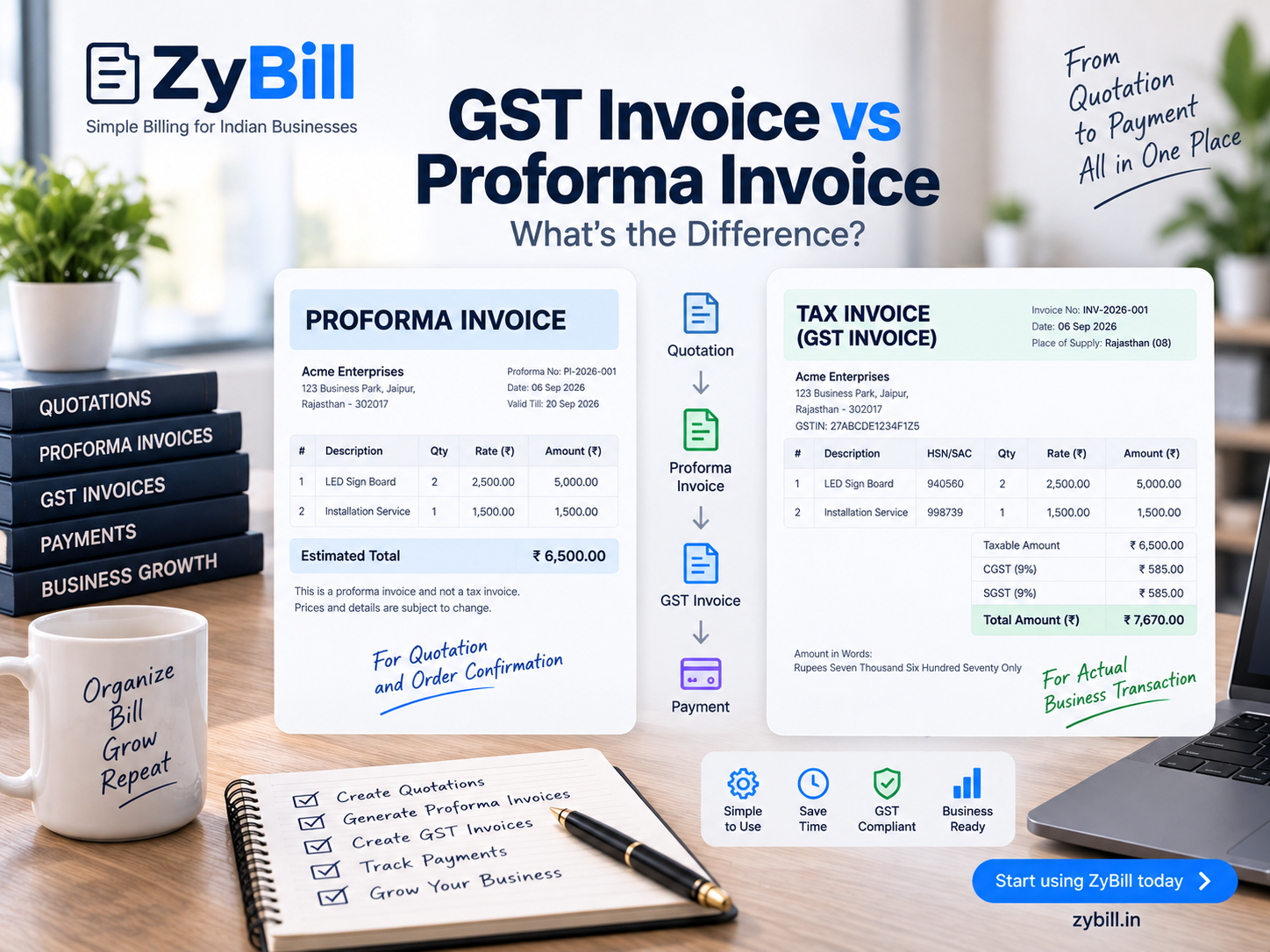
GST Invoice and Proforma Invoice Are Not the Same
Businesses often use different documents during a sale. Two documents that can look similar but serve different purposes are a GST invoice and a proforma invoice.
Understanding the difference can help you maintain clearer business records and send the right document at the right stage of a transaction.
What Is a Proforma Invoice?
A proforma invoice is generally a preliminary document sent to a customer before the final sale is completed.
It can give the customer an idea of the expected transaction, including details such as:
Products or services
- Quantities
- Rates
- Estimated taxes
- Expected total amount
- Customer details
- Terms or other relevant information
Think of it as a structured preview of the expected invoice rather than the final tax invoice.
For example, a customer may want to review the final pricing and transaction details before confirming an order. A business can provide a proforma invoice for this purpose.
What Is a GST Invoice?
A GST invoice, commonly referred to as a tax invoice in GST transactions, is issued for an actual taxable supply where applicable.
Depending on the transaction, it may contain information such as:
Supplier name and address
- GSTIN
- Invoice number
- Invoice date
- Customer details
- Customer GSTIN, where applicable
- HSN or SAC
- Description of goods or services
- Quantity and rate
- Taxable value
- GST rate
- CGST and SGST or IGST
- Total invoice value
The exact requirements depend on applicable GST rules and the nature of the transaction.
GST Invoice vs Proforma Invoice
Here is the basic difference:
| GST Invoice | Proforma Invoice |
| ---------------------------------------------- | --------------------------------------------------- |
| Represents an actual transaction | Preliminary document |
| Used for final billing | Used before final billing |
| Can record applicable GST on the actual supply | May show estimated tax information |
| Forms part of business transaction records | Helps communicate expected transaction details |
| Payment can be tracked against the invoice | Usually does not represent the final amount due |
| Issued at the applicable stage of supply | Commonly issued before the transaction is finalized |
When Should You Use a Proforma Invoice?
A proforma invoice can be useful when a customer needs detailed pricing before the final invoice is issued.
For example:
A customer asks your business to supply products worth ₹50,000.
Before confirming the transaction, they want a formal document showing the products, quantities, prices and expected taxes.
You can create a proforma invoice containing those details.
Once the transaction is confirmed and the applicable stage for issuing the final invoice is reached, the business can create the appropriate final invoice.
When Should You Use a GST Invoice?
A GST invoice is used when you need to document an actual taxable transaction under applicable GST requirements.
It becomes part of your billing records and can be connected with payments, outstanding amounts and other business records.
This is why businesses should avoid treating a proforma invoice as though it were the final GST invoice.
What About a Quotation?
A quotation is another document commonly used before a sale.
Although quotations and proforma invoices can contain similar pricing information, businesses may use them at different stages of their sales process.
A simple workflow could look like:
Quotation → Proforma Invoice → GST Invoice → Payment
Not every business or transaction needs every step. The appropriate workflow depends on how your business operates and the nature of the transaction.
Can a Proforma Invoice Be Converted Into an Invoice?
Yes, billing software can make this process much easier.
Instead of entering the same customer and item information again, a business can use the information from an existing proforma invoice to prepare the final invoice.
ZyBill supports a workflow where a proforma invoice can be converted into a draft invoice, allowing the business to review the information before finalizing it.
This reduces repetitive data entry and helps maintain consistency between documents.
Why Managing These Documents Together Matters
As a business grows, documents can quickly become scattered across spreadsheets, PDFs and different applications.
Keeping related documents in one billing system makes it easier to manage:
- Quotations
- Proforma invoices
- GST invoices
- Payments
- Outstanding amounts
- Delivery challans
- Credit and debit notes
- Customers
- Products and services
The result is a more organized billing workflow.
Create GST and Proforma Invoices with ZyBill
ZyBill is designed to simplify everyday billing for Indian businesses.
You can manage customers and products, prepare proforma invoices, create GST invoices, track payments and maintain other important business documents from one workspace.
Instead of rebuilding transaction details at every stage, ZyBill helps keep your billing workflow connected and organized.
Simplify Your Business Billing
The key distinction is simple:
A proforma invoice provides preliminary transaction information. A GST invoice documents the actual taxable transaction when applicable.
Knowing when to use each document can help your business maintain cleaner and more professional billing records.
Start using ZyBill today at zybill.in
Note: This article provides general information and is not tax or legal advice. GST requirements can vary based on the transaction and may change over time. Consult a qualified tax professional regarding requirements applicable to your business.